When industrial tags need to last longer than the carton
Industrial tags are not simple labels. They are often used on plant equipment, cable bundles, chemical containers, warehouse stock, safety points and maintenance records, so the cut has to stay accurate even when the substrate is thick or awkward. In many jobs the printed face is only part of the story. The die must give a clean edge for tear resistance, neat stacking and trouble free feeding on press.
We regularly assist converters making tags for factories in Germiston, Wadeville, Alrode, Pinetown, Bellville, Pretoria East and the industrial belts around Johannesburg and Durban. The common brief is straight forward: the tag must hold up in heat, damp storage and rough handling, but still run at production speed. That means the tooling choice matters as much as the board or synthetic stock.
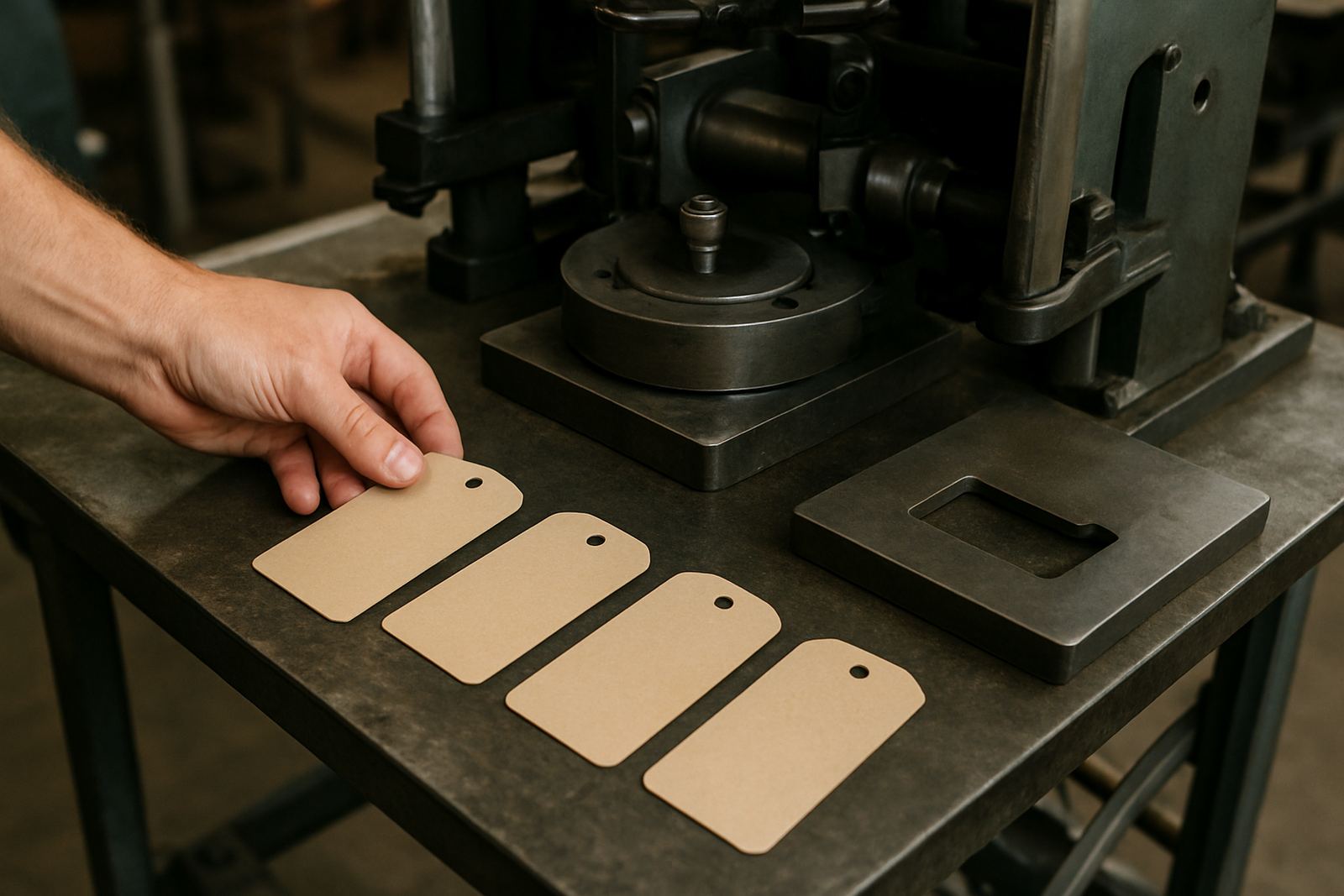
For many tag jobs, the first question is not artwork but structure. Is it a simple rectangle with rounded corners, a hanging slot, perforation, or a shaped profile with a peel off section? Once that is clear, the die can be matched to the press and the stock, rather than forcing the press to fight the tooling.
Typical press setup for tag work
Industrial tag production is usually handled on rotary converting lines, with the tooling chosen for the run length and material. Small and medium batches often use flexible magnetic dies, while higher volume work may call for rotary solid dies or magnetic cylinders where repeat performance is important. The right setup depends on whether the converter is cutting paper tags, laminated stock, polypropylene, PVC, or a heavier synthetic sheet.
Common equipment on these jobs includes unwind and rewind units, registration sensing, slitting stations, a stripping section and a delivery or counting system. If the tag includes a hanging hole or slot, the cut shape needs to register properly with print and perforation. When the die is not set correctly the problem shows up quickly: rough edges, crushed corners, web breaks or tags that do not stack neatly.
- Rotary solid dies for longer runs and repeatable cutting
- Flexible magnetic dies for shorter to medium production runs
- Magnetic cylinders where the press setup needs a stable mounting surface
- Bearer setting and magnet checks where pressure consistency is critical
- Press trial support for new tag shapes and first production runs
Planning the layout before the first cut
Good tag production starts with layout. If the tag will be tied, wired, stapled or looped onto a product, the hole position and edge distances must allow for use in the real world, not only on the drawing. For plant identification pieces, there is also the issue of legibility. Text that looks fine on screen may disappear once the tag is cut smaller than expected.
We normally advise converters to check three things early: the finished size, the required quantity per sheet or across the web, and how the tag will be handled after converting. A tag that lives in a dusty workshop may need a slightly larger safety margin around the edges. A tag used outdoors near Durban or Gqeberha should allow for substrate movement in coastal humidity, especially where the stock is prone to curl.
If the job is going onto a customer supplied press, send the layout dimensions exactly as they will run. Small differences in repeat length, slot position or bearer height can create waste during the first run. It is better to confirm the die against the actual machine layout than to adjust on press and lose time.
Common mistakes that waste stock and time
Industrial tags often fail for reasons that are avoidable. The most common issue is choosing a cut format that is too close to the printed edge. Another is using a die that was copied from an old sample without checking whether the press, stock thickness or repeat length has changed. Even a small difference can affect stripping and delivery.
Converters also run into trouble when the tag shape is too intricate for the material. Sharp internal corners can lift on synthetic stock, while thin necks and fine slots can tear during rewind. If the stock is coated one side only, the cut quality may vary across the web and need closer adjustment. We have seen plenty of jobs where a simple shape would have reduced scrap and improved press speed.
- Ignoring clearance around holes, ties and perforations
- Using the wrong die hardness for the substrate
- Copying an old sample without confirming dimensions
- Overcomplicating the shape when a cleaner profile will run better
- Skipping magnet checks and bearer setting before a first run
Budget ranges for industrial tag tooling in Rand
Budget depends on the number of repeats, the size of the tag, the complexity of the outline and whether the tooling is a one off or part of a repeat production schedule. For straightforward industrial tag dies, smaller jobs can start in the low thousands of Rand, while more detailed rotary tooling or cylinder work can move higher depending on specification. If you need matching to an existing setup, expect extra time for measurement and proofing.
As a broad guide, flexible magnetic dies for simpler tag shapes are often the most cost effective way to begin. Rotary solid dies and magnetic cylinders are better where volume, consistency and edge finish justify the spend. If a converter is planning a steady supply to Johannesburg, Pretoria, Durban or Cape Town clients, it is usually worth factoring in repeat matching and a backup plan for urgent remakes.
We also advise allowing a margin for packing and dispatch, especially when production is tied to customer deadlines. A rushed schedule can be more expensive than the tooling itself if the job has to be rerun because the first trial was not properly checked.
What to send for an accurate quote
For industrial tags, an accurate quote comes from the tag size, material and how it will be fixed. We need the finished size, material type, quantity, repeat length if applicable, and a simple note on how the tag will be used. If you are replacing an existing die, send a sample with measurements or the previous drawing. If the job is new, a rough sketch is enough to start the technical check.
Our team in Wadeville, Germiston handles die design, CAD proofing, machine shop work and dispatch coordination in house, so the quote can be matched to the actual production method rather than guessed. Marius Jacobus van der Merwe oversees the operation, with Thandiwe Nkosi managing production, Ruhan de Beer handling technical sales, Nirasha Ramdass on CAD, Siyanda Letsoalo leading the machine shop, and Anele Mthembu coordinating packing and dispatch. That means the details are checked by people who understand both the drawing and the press.
If your business needs supply into Germiston, Johannesburg, Pretoria, Durban, Pinetown, Cape Town, Bellville or Gqeberha, we can plan for delivery timing and urgent remake support where needed. Industrial tags need to arrive ready for production, not as a guess, and that is where careful tooling saves time.
Why repeat work gets easier when the tooling is right
Once a tag format is set up properly, repeat orders become far simpler. The die cuts cleaner, the press runs steadier, and the stock usage is more predictable. That matters for converters supplying maintenance departments, warehouses, mining support, transport firms and industrial clients who expect the same tag shape every time.
We handle repeat matching, cylinder refurb, die regrind and stock advice when a long running job starts to drift or when the original tooling is wearing down. Coastal humidity, heavy shift work and frequent changeovers all affect the life of a die, so regular checks are worthwhile. A small adjustment now can prevent a much bigger stoppage later.
If you are producing industrial tags for South African conditions, keep the shape practical, the layout clear and the tooling matched to the press. The result is less waste, better packing and fewer complaints from the customer on the other side.