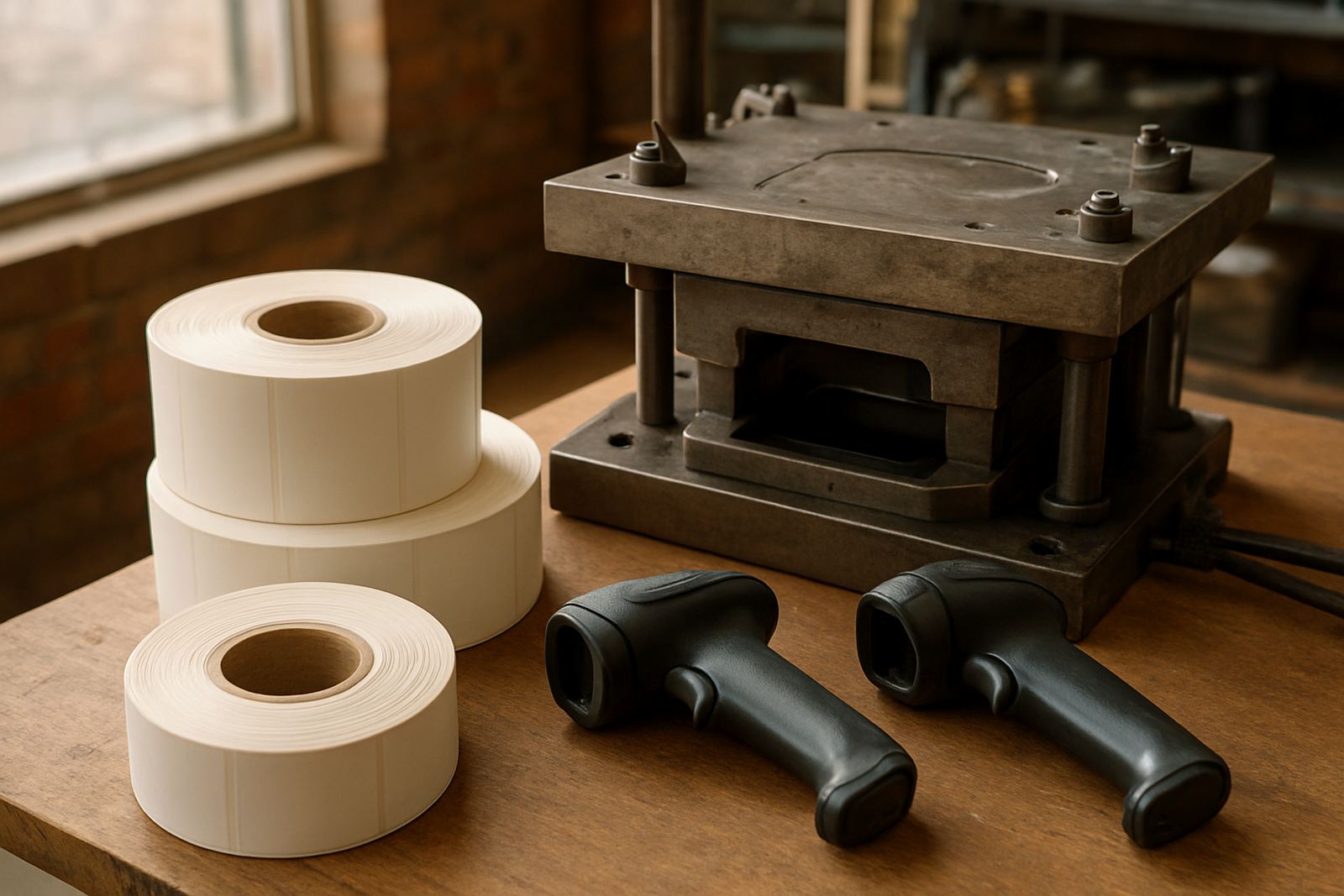
High-volume labels for stock rooms, depots and transport runs
Logistics labels usually have one job: move quickly through the system and still scan, peel and stick properly at the end of the line. That means the die has to suit the substrate, the press speed and the finishing method. In Germiston and Wadeville we work with printers making waybills, pallet labels, carton labels, route labels, barcode labels and return labels in repeat volumes. Some are printed on paper facestock, others on polypropylene or self-adhesive material with a stronger liner for rough handling.
For Gauteng depots, Durban ports and Cape Town distribution centres, the challenge is often not the artwork, it is the tolerance. If the label is off by even a fraction, you get edge lift, bad stripping or a label that will not sit square on the carton. We machine for repeatability, so if a client comes back for the same job after six months the cut still matches the approved spec.
Typical tooling set for logistics label production
Most logistics label work uses one of three tooling routes, depending on press type and run length. Rotary solid dies suit high-speed converting where durability and long repeat runs are needed. Flexible magnetic dies are practical for shorter runs, mixed sizes and frequent changeovers. Magnetic cylinders come into play when the printer needs a stable repeat job on compatible rotary equipment.
Common sizes include small 50 x 25 mm barcode labels, 100 x 50 mm shipping labels, A7 and A6 variants, plus custom strip labels for picking bins and shelf edge use. When the label carries a barcode or QR code, the cut must not distort the print area. We also check bearer setting and magnet condition where needed, because a worn setup can make even a good die perform badly.
- Rotary solid dies for high-volume carton and pallet label runs
- Flexible magnetic dies for frequent size changes and shorter batches
- Magnetic cylinders for compatible repeat production jobs
- Repeat matching for existing label sizes and archived tooling specs
- Urgent remakes when a job must get back into production quickly
Planning the layout before the first cut
A logistics label should be planned from the press back to the warehouse use case. Start with how the label is applied, by hand, applicator or on press, then confirm the final carton size, pallet format and reading distance. If the client wants labels for cold rooms, coastal humidity in Durban or rough handling through Johannesburg depots, the adhesive choice and facestock thickness matter as much as the die. We ask for the current sample if possible, because a small change in corner radius or gap spacing can make stripping cleaner and reduce waste.
CAD proofing helps here. It allows us to check the repeat, blade profile and cut position before manufacture. It also gives the printer a chance to confirm text safe areas, barcode placement and the direction of feed. On multi-size orders, we group related tooling where possible to keep changeovers practical and reduce down time when loadshedding interrupts a shift and the line has to restart later that night.
- Confirm the label size in millimetres, not only by description
- Allow enough gap for stripping and waste removal
- Keep barcode zones clear of cut lines and edge pressure
- Test the adhesive on the actual carton stock or wrap material
- Plan for storage conditions, especially heat, dust and humidity
Common mistakes that cause waste on the line
One of the biggest mistakes is assuming a previous label size will still fit without checking the latest carton or pallet spec. Warehouses change pack sizes, transport labels move from paper to synthetic stock, and the old die suddenly causes overlap or poor peel. Another issue is ordering a cheap tool for a high-speed job and then expecting long life from it. That usually leads to uneven cut pressure, ragged edges or a die that needs regrinding too soon.
We also see trouble when the printer only sends artwork and not the physical sample. Artwork alone does not show liner thickness, adhesive drag or whether the label has been running in a hot dispatch area. For clients in Pretoria, Pinetown and Bellville who run mixed stock, it pays to check the whole line, from unwind to rewind. A small fault at the die stage can turn into cartons blocked for relabelling, and nobody wants that at month-end.
- Using the wrong material for damp stores or chilled goods
- Skipping a press trial on the actual production setup
- Ignoring worn magnetic checks or poor bearer setting
- Ordering by artwork only and not by measured sample
- Leaving repeat jobs too late, then paying for an urgent remake
Budget ranges for South African logistics label tooling
Pricing depends on size, material, quantity and whether the job is a first-off or a repeat. As a general guide, smaller flexible magnetic dies for simple logistics labels can start from about R1 800 to R3 500 each, depending on the cut complexity. More detailed or larger flexible tools often sit between R3 500 and R7 500. Rotary solid dies and magnetic cylinders are typically higher, with many orders ranging from R6 500 to R18 000 or more where the dimensions, finish and volume demand tighter machining.
For a warehouse group running several label sizes across Johannesburg, Durban and Cape Town, it is often cheaper to standardise the main ranges and keep one spare of the high-use sizes. That reduces stoppages and makes dispatch easier when a batch goes missing or a job comes in unexpectedly. We can also advise on stock holding for repeat label tooling, so the printer does not need to wait on a fresh manufacture every time there is a spike in orders.
Final cost is affected by regrind work, cylinder refurbishment, packing and delivery coordination, and whether the job needs a same-week turnaround. If you need the tooling in a hurry, say so early. It helps us plan the machine shop time and dispatch route without wasting a day on back-and-forth.
What our team checks before dispatch
Before any logistics label tool leaves Wadeville, we check the cut dimensions, feed direction, repeat accuracy and job notes. The production team verifies the spec, technical sales confirms the application detail, and dispatch makes sure the packing is suitable for transport to Johannesburg, Pretoria, Durban, Cape Town, Gqeberha or surrounding areas. Where needed, we can also advise on repeat matching, stock advice and press trial support so the next run starts cleanly.
Clients usually send their enquiry through the form on our contact page, then we work through the measurements, usage and deadline. That approach keeps the job practical and prevents avoidable delays. For logistics labels, the difference between a good run and a frustrating one is often just careful planning and a die that is made to the actual production reality, not a guess.